There is no better way to experience Rwanda than from behind the wheel. The country is small enough to drive across in a day, yet diverse enough to fill a fortnight with entirely different landscapes, ecosystems, and encounters at every turn. From the misty volcanic peaks of the northwest to the open savannah of the east, from the ancient rainforests of the southwest to the shimmering lakeside towns of the west, Rwanda rewards independent travelers who take the road less travelled — and those who take the road everyone should travel.
Rwanda’s road infrastructure is among the finest in East Africa. The government’s sustained investment in transport networks has produced an impressive system of paved highways connecting all major cities and tourist destinations, with well-maintained tarmac roads radiating outward from Kigali in every direction. Traffic drives on the right, road signs are bilingual in English and Kinyarwanda, digital navigation works reliably across most of the country, and Rwanda consistently ranks among Africa’s safest countries for independent travel.
This guide from Rwanda Car Rental Services covers the ten essential roads and routes that every Rwanda self drive visitor should know — what to expect on each one, what to stop for, which vehicle to use, and how to plan your time. Whether you are chasing gorilla permits, Big Five sightings, chimpanzees, canopy walks, lakeside sunsets, or cultural history, one of these roads leads there.
Before You Hit the Road: Key Rules for Driving in Rwanda
Before exploring the ten routes, every self-driver needs to understand Rwanda’s essential driving rules. These are consistently enforced, and the consequences of ignoring them are real.
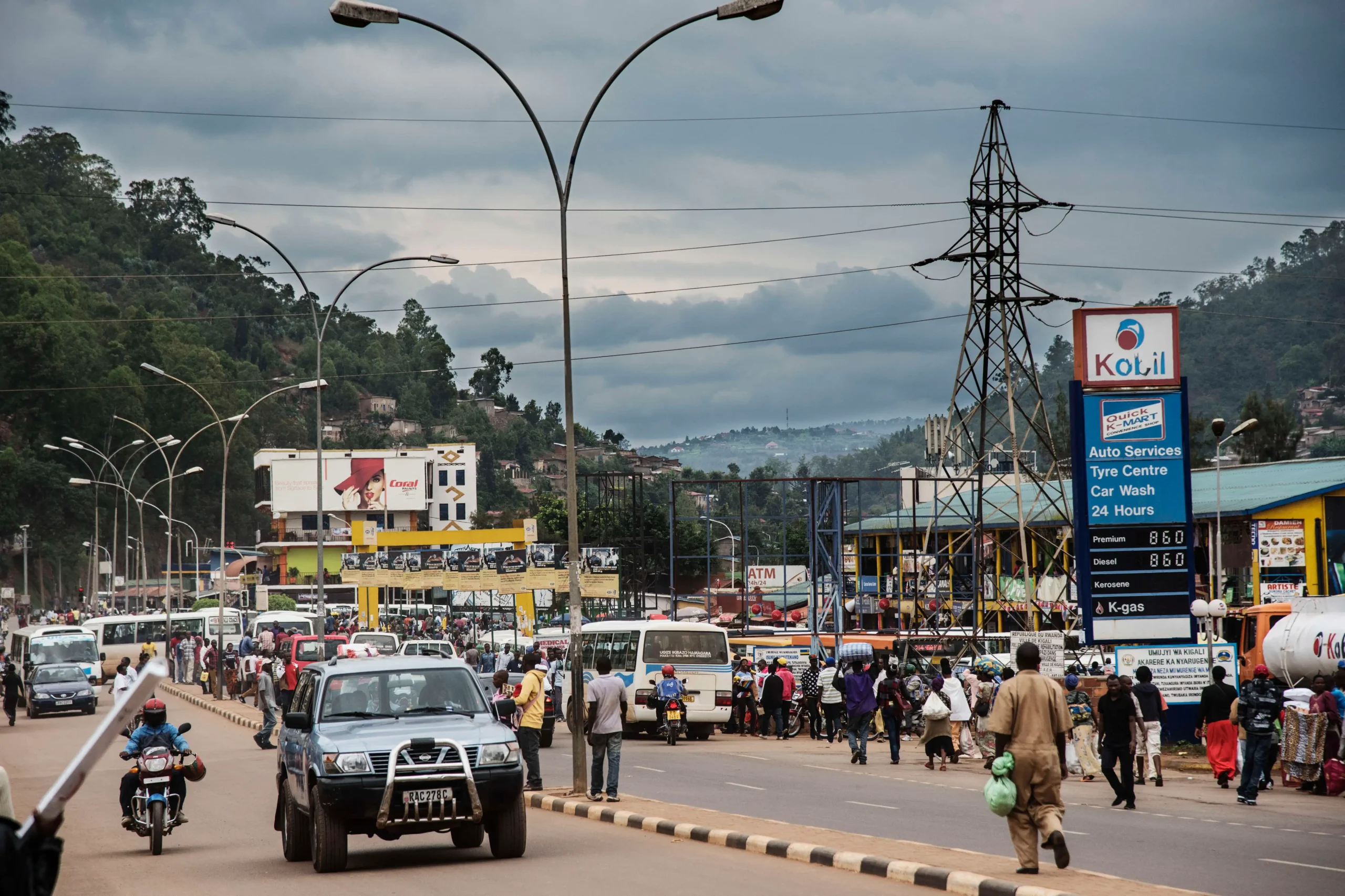
Drive on the right. Rwanda follows right-hand traffic, in common with most of continental Africa.
Speed limits are strictly enforced. Urban and residential areas: 40–50 km/h. Open highways: 80–100 km/h. Inside national parks: 40 km/h maximum. Police checkpoints are common throughout the country — stay polite, greet officers respectfully, and keep all documents accessible.
Documentation required: A valid national driver’s license (held for at least one year) plus an International Driving Permit (IDP), obtained before arrival in your home country. Rwanda accepts IDPs alongside your national license for up to one year. Rental companies will also require your passport and a credit card for the security deposit.
Avoid night driving. Poor lighting on rural roads, pedestrians, livestock, and unpredictable hazards make nighttime driving genuinely risky. The US Embassy in Kigali prohibits its own staff from driving outside the capital after 6:00 PM — a useful benchmark. Plan all inter-destination driving to conclude well before dusk.
No plastic bags. Rwanda’s national plastic bag ban is enforced at airport entry. Do not bring single-use plastic bags into the country.
Car-free day in Kigali. On the last Sunday of each month, major roads in Kigali are closed to vehicles from 7:00 AM to 11:00 AM for cyclists and pedestrians. Plan around this if your journey starts from the capital.
Download offline maps. Google Maps and Maps.me both work well in Rwanda. Download offline maps for your entire route before departure, as signal can drop in remote areas and within forest zones.
Fuel up strategically. Fuel is widely available in towns and along major routes. However, stations are sparse near Nyungwe Forest and within park boundaries. Always fill your tank before entering any national park or remote highland area. Fuel prices are regulated nationally, so rates are consistent across the country.
Now — the ten roads every visitor must know.
Road 1: Kigali to Musanze — The Gateway to the Gorillas
Distance: ~105 km | Drive Time: 2 to 2.5 hours | Road Condition: Excellent paved highway | Best Vehicle: Any 4WD or well-maintained sedan
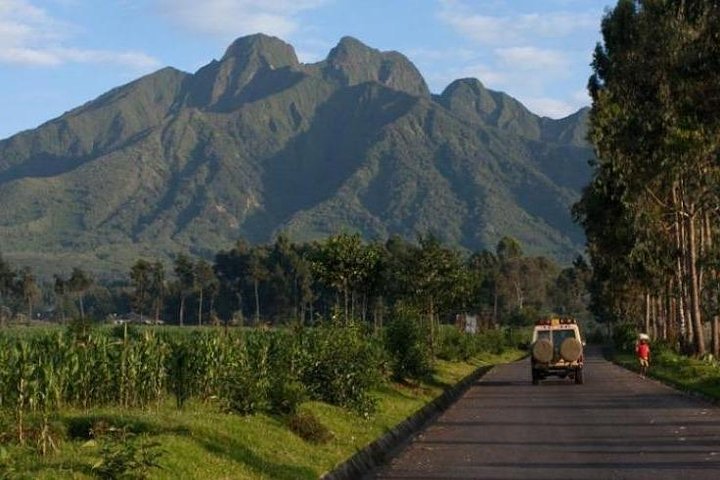
This is Rwanda’s most traveled tourist route and one of its finest driving experiences. The highway linking Kigali to Musanze (formerly Ruhengeri) in the northwest is a smooth, well-maintained artery that runs through the very heart of Rwanda’s thousand hills. It is the road you will drive if you have a gorilla permit — and if you do, you will never forget the moment the Virunga volcanoes first appear on the horizon.
Leaving Kigali heading northwest, the city gives way rapidly to a landscape of terraced hillsides, market towns, and valley farms. The road climbs through the Rulindo and Gakenke districts, passing through small towns where roadside vendors sell avocados, bananas, and sugarcane from open-air stalls. The air cools noticeably as altitude increases. Around 80 kilometers from the capital, the terrain shifts dramatically as the volcanic peaks of the Virunga range — Karisimbi, Bisoke, Muhabura, and the others — begin to dominate the horizon. On clear mornings, the volcanoes are visible from astonishing distances.
As you approach Musanze, the town feels like a basecamp — because it is. This is the staging city for Volcanoes National Park, home to the mountain gorilla. The park’s Kinigi Headquarters, where all gorilla trek briefings begin at 7:00 AM, is approximately 15 kilometers beyond Musanze town.
What to stop for: The twin crater lakes of Burera and Ruhondo sit northeast of Musanze and are among the most scenically striking detours in Rwanda. Their deep blue waters reflect the volcanic peaks above them. A short detour adds 30–45 minutes but repays generously in photographs.
Rwanda Car Rental Services Tip: An early departure from Kigali (no later than 5:00 AM on trek days) ensures you reach Kinigi comfortably before the 7:00 AM briefing. We strongly recommend overnight accommodation in Musanze the night before your trek, and we can arrange your vehicle for a morning pickup to the park gate.
Road 2: Kigali to Akagera National Park — The Big Five Highway
Distance: ~100–110 km | Drive Time: 2 to 2.5 hours | Road Condition: Excellent paved highway to the park gate; variable unpaved tracks inside | Best Vehicle: 4WD essential for park interior
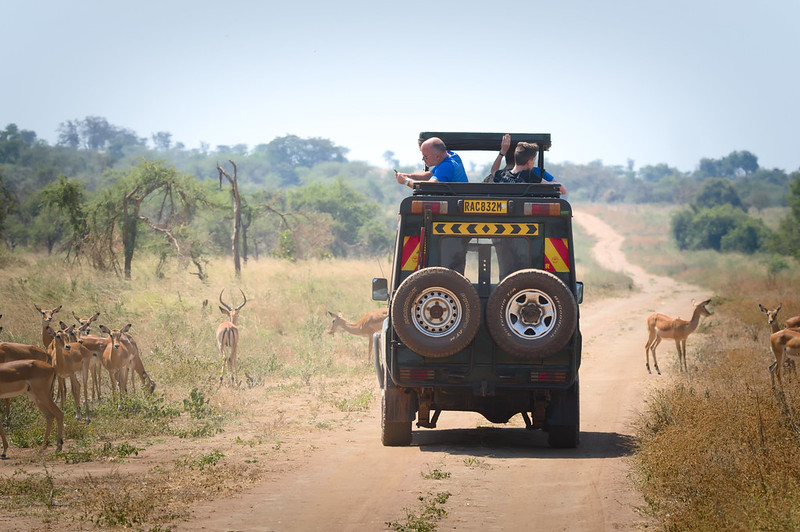
Rwanda’s only savannah game park lies in the country’s northeast, along the Tanzania border, and the drive from Kigali to the Akagera South Gate is one of Rwanda’s great landscape transitions. From Kigali, you head east through the Kayonza district, and the scenery transforms gradually from the steep, green, terraced hillsides that define central Rwanda into a flatter, warmer, more open terrain — the beginning of East Africa’s great savannah corridor.
The road east from Kigali to Kayonza is one of the country’s best-maintained highways. The final kilometers to the park gate are well-signposted. Inside the park, however, the road character changes entirely: unpaved tracks, steep ridges, and — during the wet season — mud that will challenge any vehicle without 4WD. The park’s internal north-south circuit from the southern gate to the northern gate takes up to seven hours of game-driving and is one of the most thrilling self-drive experiences available anywhere in East Africa.
What to stop for: The Kayonza town market, about 80 kilometers from Kigali, is a lively, authentic midway stop for fresh produce and local food. Beyond the market, keep your eyes on the roadside — the approach to the park gate offers occasional glimpses of savannah animals and marabou storks circling overhead.
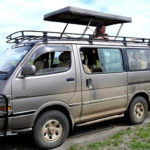
Rwanda Car Rental Services Tip: A 4WD with decent ground clearance is non-negotiable for Akagera. Park gates open at 6:00 AM — departing Kigali by 3:30–4:00 AM gets you there at opening for the best early morning game drive conditions. We offer pop-up roof Land Cruisers specifically configured for game-drive photography.
Road 3: Kigali to Huye — The Southern Cultural Highway
Distance: ~135 km | Drive Time: 2 to 3 hours | Road Condition: Excellent paved highway (RN1) | Best Vehicle: Any well-maintained vehicle
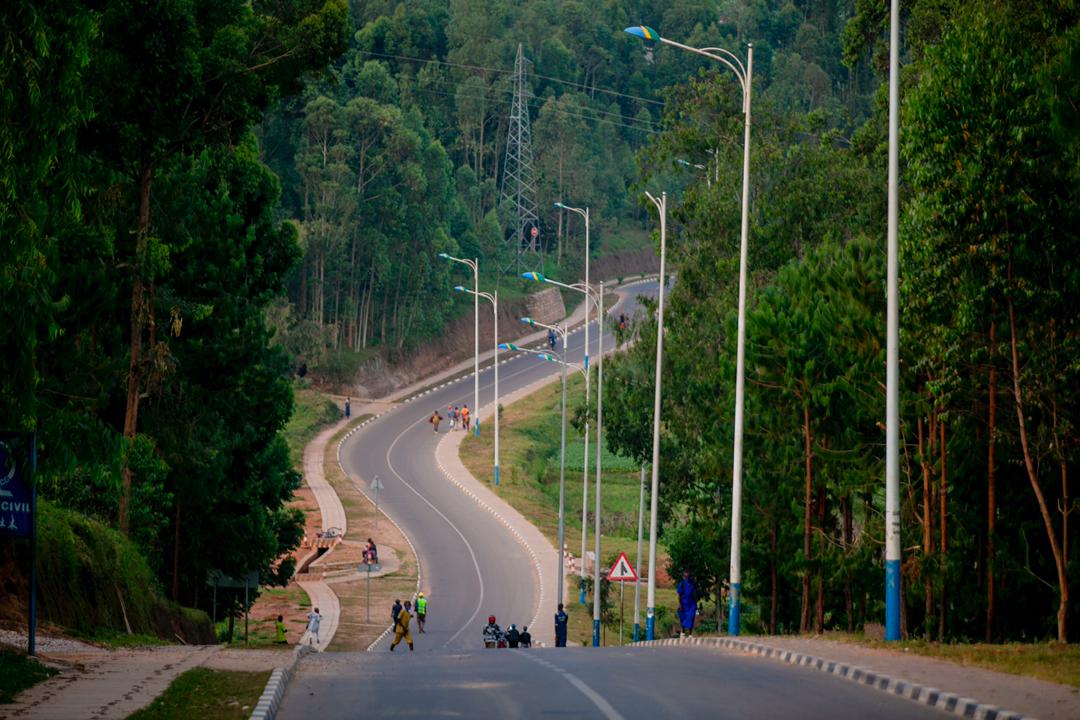
The main RN1 highway runs south from Kigali through the Southern Province to Huye (formerly Butare), Rwanda’s intellectual and cultural capital. This is Rwanda’s great cultural road — the route through the country’s academic heartland, royal heritage sites, and historical memory.
The drive south is slower and more varied than the rush north toward the gorillas. Hills roll in waves, passing through tea-growing communities, banana groves, and small towns with their characteristic bright blue and red buildings. Around 80 kilometers from Kigali, you pass through Nyanza, the seat of Rwanda’s pre-colonial kingdom. The Nyanza Royal Palace Museum is one of the most important cultural stops in the country — a meticulously restored royal residence that tells the story of the Mwami (king) and the Inyambo, the long-horned royal cattle that were once symbols of the kingdom’s power.
Arriving in Huye, you encounter one of Rwanda’s most important intellectual centers. The National Museum of Rwanda (also known as the Ethnographic Museum) houses one of the finest collections of traditional Rwandan artifacts, instruments, agricultural tools, and ceremonial objects on the continent. It is also home to the National University of Rwanda, giving the town a distinctly youthful and academic atmosphere unlike anywhere else in the country.
What to stop for: The Nyanza King’s Palace Museum is a genuine highlight of any Rwanda road trip. Allow at least 90 minutes. In Huye itself, the National Museum warrants a thorough two hours, and the town’s local restaurants offer some of the best traditional Rwandan cuisine outside Kigali. Brochettes (skewered meat), isombe (cassava leaves), and fresh-pressed juice are roadside staples.
Rwanda Car Rental Services Tip: This route is very comfortable in a standard sedan or compact SUV. It is also the first leg of the longer journey south to Nyungwe, making it naturally part of a multi-day southern circuit. Fuel up in Huye before continuing south.
Road 4: Huye to Nyungwe Forest — The Green Cathedral Road
Distance: ~90 km from Huye | Drive Time: 2 to 2.5 hours | Road Condition: Paved but increasingly winding; hairpin bends on the final ascent | Best Vehicle: 4WD strongly recommended
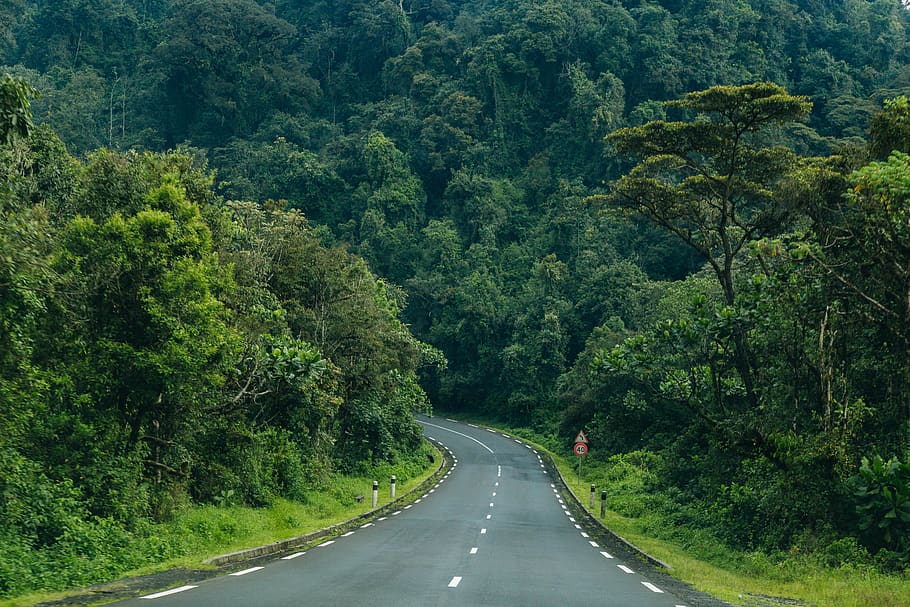
Continuing south from Huye along the RN1, the road climbs steadily into one of Africa’s most ancient and extraordinary landscapes. The route to Nyungwe Forest National Park is among the most beautiful drives in Rwanda — and by the time you have completed it, you will understand why that claim is not lightly made.
From Huye, the highway passes through Gikongoro (Nyamasheke district) and enters the tea plantation country of Rwanda’s southwestern highlands. These plantations are extraordinary — rolling hills carpeted entirely in the symmetrical, emerald geometry of tea bushes, harvested by women in brightly colored umushanana wraps who move between the rows with wicker baskets on their backs. The contrast between the human order of the plantations and the wild canopy of Nyungwe immediately ahead is one of the most visually striking transitions you will experience on any road in Africa.
The final stretch to the park entrance features hairpin bends that climb into the montane rainforest. Morning mists often cloak the canopy on this section, reducing visibility and demanding careful, controlled driving. The air becomes noticeably cooler and heavier with moisture. By the time you reach the park gate, you have the distinct sensation of entering another world entirely.
Inside the park, the road continues along a single paved route through the forest, with trailheads branching off toward chimpanzee tracking points, the famous canopy walkway suspended 60 meters above the forest floor, and various waterfalls and birding spots. Over 500 bird species inhabit Nyungwe, including many Albertine Rift endemics found nowhere else on Earth.
What to stop for: The tea plantations between Huye and Nyungwe are mandatory photograph stops. The canopy walkway inside the park is one of Rwanda’s most remarkable tourist experiences — book your permit in advance through the RDB. Chimpanzee tracking permits, also booked through the RDB, give access to Nyungwe’s population of over 500 chimpanzees.
Rwanda Car Rental Services Tip: Fuel is very scarce on this route south of Huye. Fill your tank completely in Huye before departure. A 4WD is strongly recommended, especially during the wet season when the mountain approaches can become genuinely slippery. Arriving before dark is essential — finding lodges within the forest after nightfall is disorienting and potentially hazardous.
Road 5: Kigali to Rubavu (Gisenyi) — The Western Corridor
Distance: ~167 km | Drive Time: 3 to 3.5 hours | Road Condition: Excellent paved highway with some climbing sections | Best Vehicle: Any well-maintained vehicle; 4WD preferred
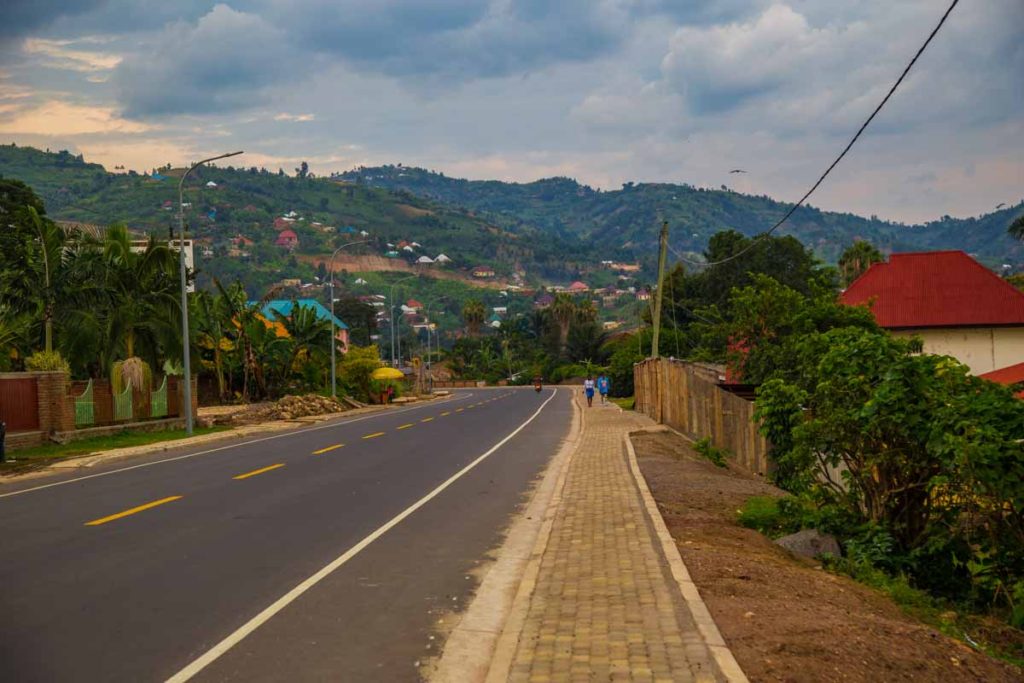
The road from Kigali to Rubavu (the renamed lakeside city formerly known as Gisenyi) on the northern shore of Lake Kivu is one of Rwanda’s most geographically dramatic driving experiences. It is also the most direct route to the Congolese border town of Goma, making Rubavu one of the most internationally connected towns in the country.
From Kigali, the route west climbs through progressively higher terrain. The road passes through Musanze in the north before descending dramatically toward the lake — a descent that is among the most spectacular in all of Rwanda. As you drop from the volcanic highlands toward Rubavu, Lake Kivu opens below you in the full breadth of its extraordinary beauty: one of Africa’s Great Rift Valley lakes, stretching 90 kilometers from north to south, its deep blue surface fringed by green hills and island silhouettes, with the Congolese mountains rising beyond the far shore.
Rubavu itself has the atmosphere of a Mediterranean lakeside resort town — broad, tree-lined streets, beachfront promenades, lively restaurants serving fresh tilapia, and a cosmopolitan air generated by the constant border traffic between Rwanda and the DRC. The town’s hot springs, a short drive from the center, offer a remarkable opportunity to soak in geothermally heated water within sight of Lake Kivu.
What to stop for: The viewpoints along the descent to Rubavu offer some of the finest photography opportunities in Rwanda. The hot springs on the outskirts of town are well worth 90 minutes of your time. Napoleon Island, accessible by boat from the Rubavu waterfront, is home to thousands of fruit bats and offers panoramic views of the entire northern lake basin. The proximity of Rubavu to Volcanoes National Park (approximately 1 hour) makes it an excellent alternative base for gorilla trekkers who want a scenic lakeside stay.
Rwanda Car Rental Services Tip: This road is comfortable in a well-maintained sedan on its paved sections. However, the descent to Rubavu includes steep grades that reward drivers with good braking technique and patience. Do not rush this road — the scenery demands slow, attentive driving and regular stops.
Road 6: The Congo Nile Trail — Rubavu to Rusizi Along Lake Kivu
Distance: ~227 km | Drive Time: Full day (6–8 hours minimum); ideally 2 days | Road Condition: Mix of excellent paved sections and challenging unpaved tracks | Best Vehicle: 4WD essential
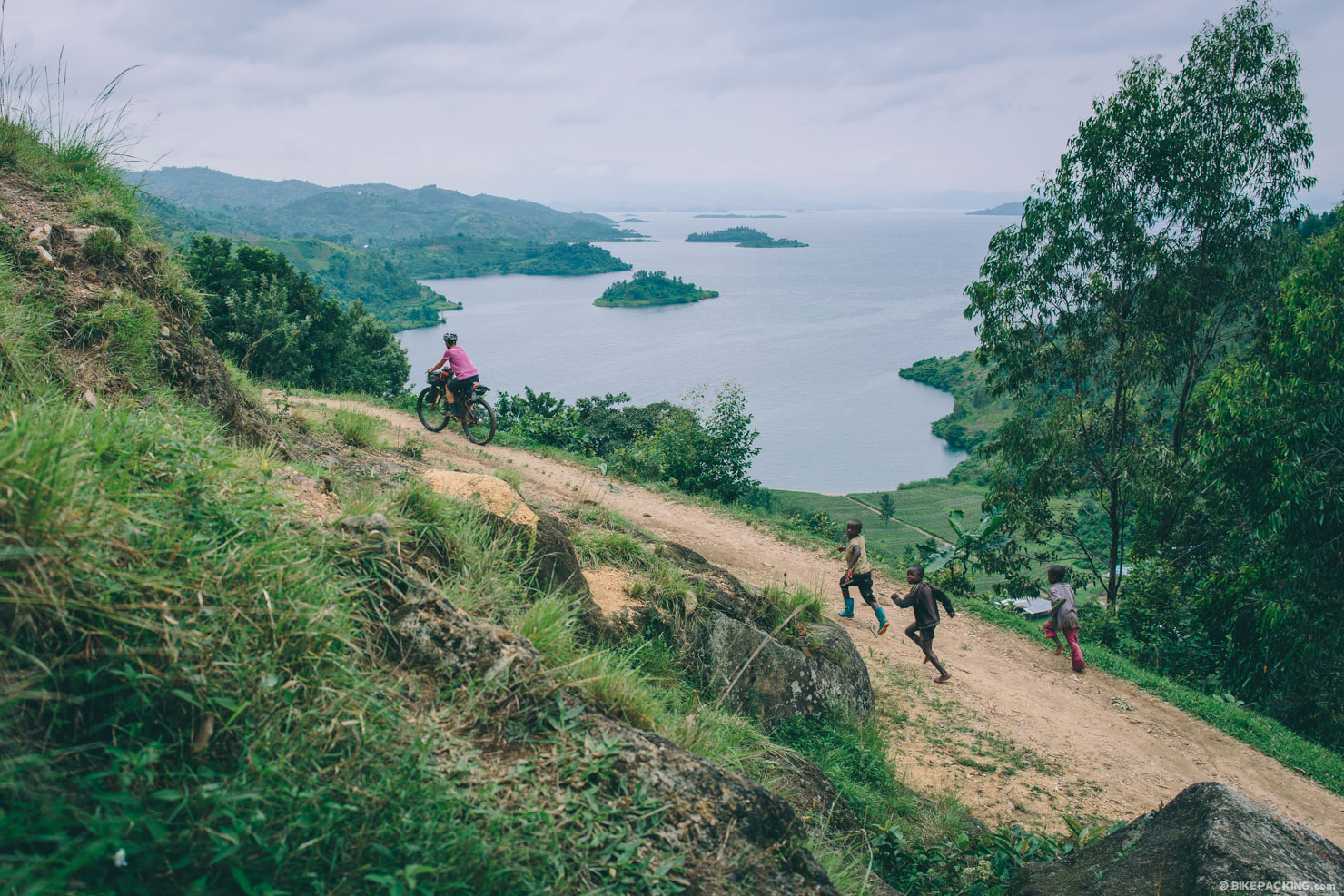
This is Rwanda’s great adventure drive — the route that seasoned travelers return home talking about long after everything else has faded. The Congo Nile Trail follows the entire eastern shoreline of Lake Kivu from Rubavu in the north to Rusizi (formerly Kamembe/Cyangugu) in the south, traversing 227 kilometers of one of East Africa’s most visually stunning landscapes.
The trail earns its name from its position along the Continental Divide — the ridge line where rainfall either flows west into the Congo River system or east toward the Nile. For much of its length, the road hugs the lake’s edge, carving through hillsides of tea and coffee plantations, rising over ridges with panoramic lake views, and descending into quiet fishing bays where wooden pirogues bob at anchor and nets dry in the lakeside breeze.
While significant sections of the route are now paved, particularly in the north and around the Karongi (Kibuye) midpoint, portions remain unpaved and require careful navigation — particularly after rain. A 4WD vehicle is essential for the full route. Some stretches feature forks and unmarked village roads where offline maps and local knowledge both become important.
The highlight of the journey for most drivers is Karongi — widely considered the most beautiful town on Lake Kivu. Perched on a peninsula surrounded by deep blue water and steep, pine-covered hills, it is a place to stop overnight, take a boat to the islands, swim in the lake, and watch the sun set over the Congo. Napoleon Island, visible from the Karongi waterfront, is accessible by boat and is famous for its spectacular colony of thousands of fruit bats.
What to stop for: Every viewpoint on this road is worth stopping for. The hilltop perspectives north of Karongi over the lake with the Virunga Mountains as a backdrop — particularly at sunset — are among the most beautiful views in all of Africa. Traditional fishing villages along the route offer genuine, unhurried encounters with Rwandan lakeside life. Tea plantation stops allow visitors to understand Rwanda’s most important agricultural export.
Rwanda Car Rental Services Tip: Do not attempt this route in a single day if you want to enjoy it. An overnight stop in Karongi is highly recommended. The route can be confusing with multiple forks and village roads — download offline maps thoroughly before departure, and consider taking a local guide for the more remote southern sections. This is not a route for cautious or inexperienced drivers.
Road 7: — The Volcanoes Approach Road
Distance: ~85 km | Drive Time: 1.5 to 2 hours | Road Condition: Paved; some steep gradients | Best Vehicle: 4WD recommended
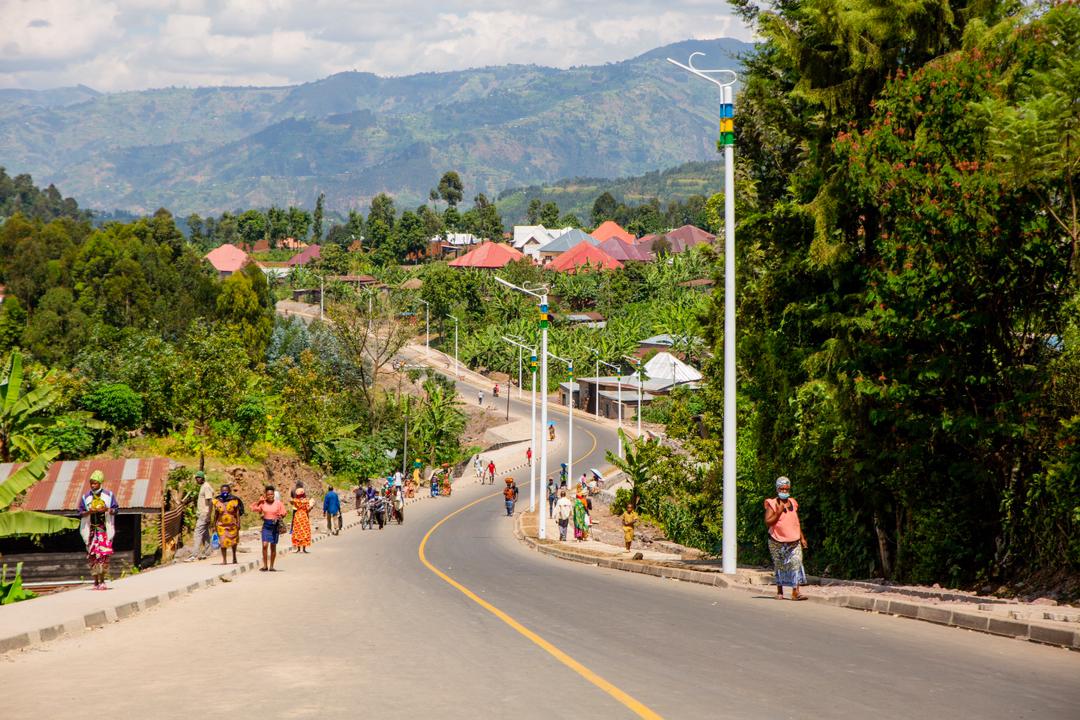
This short but spectacular road connects Rwanda’s two great northwestern destinations: Rubavu on the shores of Lake Kivu and Musanze at the base of the Virunga volcanoes. It is a road that many travelers drive as part of a larger northwest loop, and it delivers extraordinary views of both the lake and the volcanic chain.
The route climbs steeply out of Rubavu, rising rapidly from lake level toward the volcanic highlands that separate the two cities. As you climb, Lake Kivu appears in the rearview mirror in its full magnitude — a perspective unavailable from the lake towns themselves, where the surrounding hills confine your view. At higher elevations, the Virunga volcanoes emerge ahead: Karisimbi, Rwanda’s highest peak at 4,507 meters, and its neighboring peaks rising through the clouds in an impressive geological display.
The road passes through communities where farming continues at extraordinary gradients — terraces cut into hillsides so steep that the very concept of flat land seems to have been abandoned. Altitude crops — pyrethrum, wheat, potatoes — replace the banana groves of lower Rwanda, indicating the elevation gain completed in a relatively short distance.
What to stop for: The viewpoints on the high pass between Rubavu and Musanze are mandatory stops for photography. Iby’iwacu Cultural Village, on the approach to Musanze, offers an authentic and respectful introduction to the traditions of former poachers who have been successfully integrated into community-based conservation tourism. It is one of the finest cultural attractions in northwest Rwanda.
Rwanda Car Rental Services Tip: This road is frequently driven as part of a Kigali → Musanze → Rubavu → Kigali circuit. Allow extra time for the viewpoints — this is not a road to rush. During the wet season, mountain fog can reduce visibility significantly on the high sections.
Road 8: Kigali Urban Circuit — Navigating the Capital
Distance: Varies | Drive Time: Variable (allow extra for traffic) | Road Condition: Generally excellent paved city roads | Best Vehicle: Standard sedan or compact SUV; 4WD unnecessary
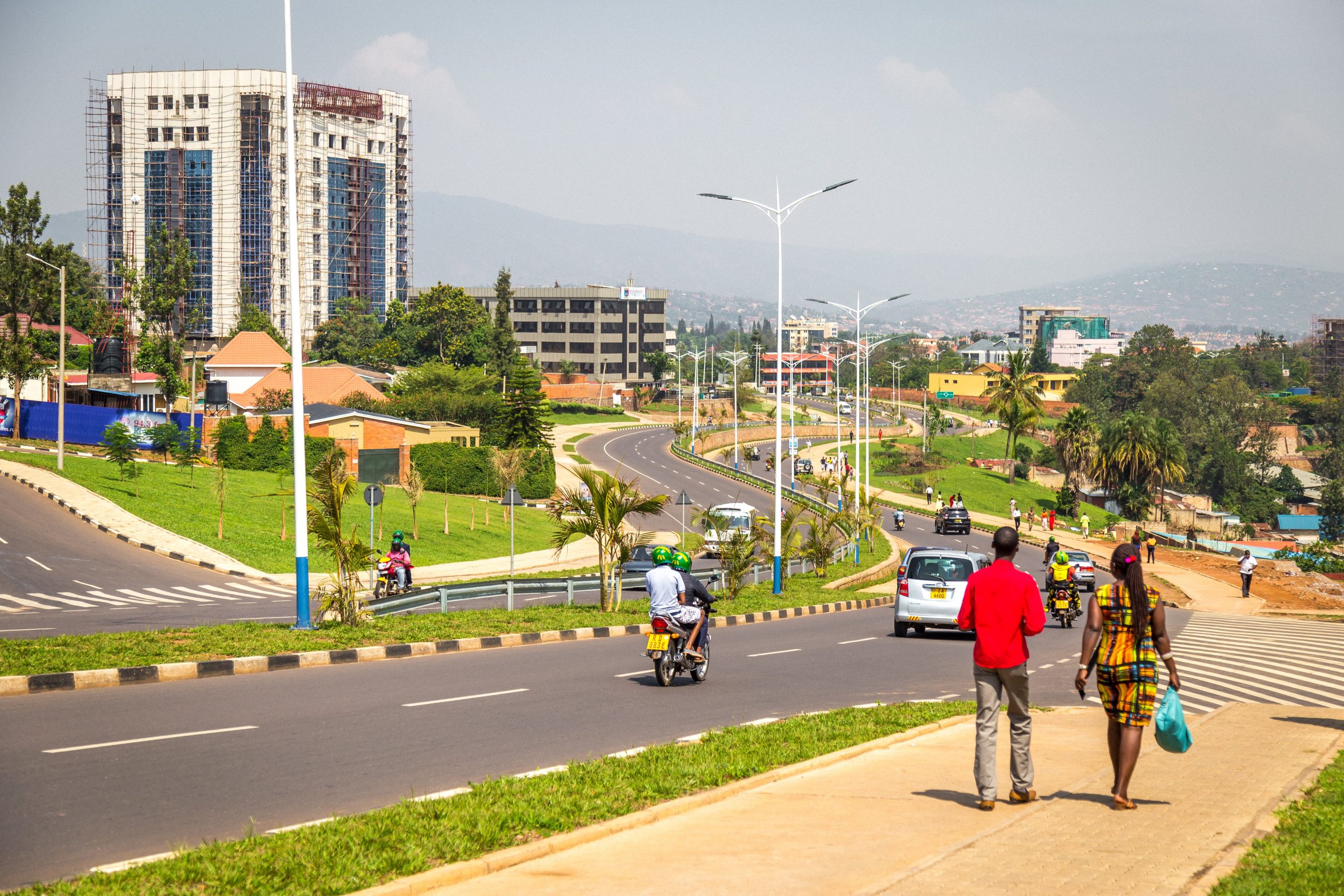
Kigali is an exceptional African capital — famously clean, orderly, well-planned, and safe. It is also built across a series of hills (naturally), which means that even urban driving in Rwanda involves gradients, switchbacks, and the occasional dramatic hilltop view over the city skyline.
For self-drivers spending time in Kigali, understanding the city’s layout is essential. The city is broadly organized into several key neighborhoods, each with its own character. Kimihurura and Kiyovu in the upmarket central district are home to the most celebrated restaurants, rooftop bars, and embassies. Nyamirambo in the southwest is the city’s most vibrant and historically layered neighborhood — a mix of mosques, markets, craftspeople, and street food that gives Kigali an authentic urban energy absent from its more polished districts. Kimironko Market in the northeast is Rwanda’s largest open-air market, where visitors can find imigongo pottery, woven baskets, handmade jewelry, and vivid fabrics.
The Kigali Genocide Memorial in Gisozi is a mandatory and profoundly important visit for any traveler to Rwanda. It marks the burial site of over 250,000 genocide victims and contains one of the most thoughtfully designed memorial museums in the world. Plan at least two hours. Approach this experience with appropriate solemnity; it is a place of grief and also, ultimately, of Rwanda’s extraordinary determination to heal.
What to stop for: Beyond the Memorial, the galleries and art spaces of Kimihurura are worth a half-day of exploration. The Inema Arts Center in Kacyiru features rotating exhibitions of contemporary Rwandan and East African art. The KCC Promenade offers upscale shopping and rooftop dining with city views. The Kigali Convention Centre — a beautiful, domed landmark visible from across the city — anchors the central business district and its adjacent hospitality zone.
Rwanda Car Rental Services Tip: Morning rush hour (7:30–9:00 AM) and evening rush hour (5:00–7:00 PM) on weekdays slow Kigali’s main roads significantly. Boda-bodas (motorcycle taxis) weave through traffic at speed — drive defensively and give them room. Parking is generally available but confirm your accommodation has dedicated guest parking before arrival. Remember the monthly car-free day (last Sunday of the month, 7:00–11:00 AM).
Road 9: Musanze to the Twin Lakes (Burera & Ruhondo) — Rwanda’s Hidden Gem Drive
Distance: ~30–45 km from Musanze | Drive Time: 45 minutes to 1 hour each way | Road Condition: Paved main route; some sections rougher toward lake shores | Best Vehicle: 4WD recommended for lake access points
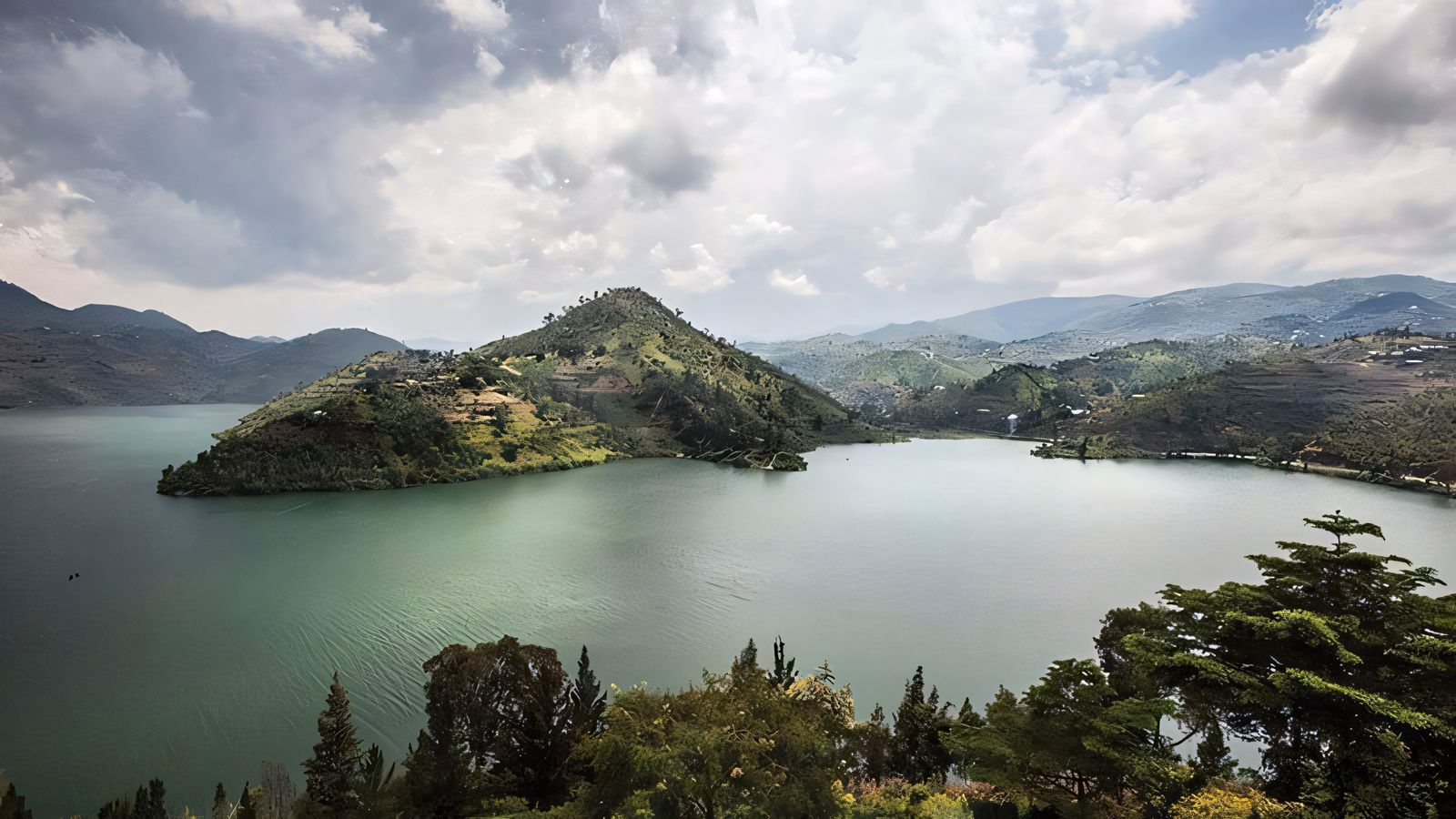
This is Rwanda’s best-kept secret drive, and Rwanda Car Rental Services is including it here precisely because too many visitors skip it. The twin crater lakes of Burera and Ruhondo sit northeast of Musanze in the Burera district, cradled between the volcanic hills on Rwanda’s border with Uganda. They are among the most visually stunning natural features in the country — and they are visited by a fraction of the travelers who pass through Musanze for gorilla permits.
The drive from Musanze takes under an hour on the main paved road, but the approach roads toward the lake shores and viewpoints become progressively rougher and require careful navigation. What awaits at the end justifies every minute of the journey. The lakes are volcanic crater lakes, their shores steeply forested, their waters an extraordinary deep blue-green that shifts with the quality of the light. The volcanic peaks — Karisimbi, Muhabura, and the Ugandan border volcanoes — frame the far horizon.
Boat trips on Lake Burera are available locally and offer a serene perspective on this little-known corner of Rwanda. Fishing communities around both lakes live in ways that have changed little in generations. The area also provides access to the Musanze Caves — an extensive lava tube cave system used as a refuge during historical conflicts and now open for guided tours.
What to stop for: The viewpoints above Lake Ruhondo from the ridge roads are among the finest photography locations in northwest Rwanda. The Musanze Caves are a fascinating underground detour — guided tours last approximately 90 minutes. Local fishing villages around both lakes offer authentic encounters away from the tourist infrastructure of Musanze town.
Rwanda Car Rental Services Tip: This drive pairs naturally with your gorilla trekking itinerary — the twin lakes make an excellent afternoon activity after your morning gorilla encounter. A 4WD is recommended for the lake shore access points, which can be muddy. Allow at least a half-day for a proper exploration.
Road 10: The Rwanda Grand Loop — The Full Country Circuit
Distance: ~800–1,000 km total | Drive Time: 7 to 14 days | Road Condition: Mix of all of the above | Best Vehicle: 4WD essential
For travelers with the time and the spirit of adventure, Rwanda rewards a complete country circuit that links every major destination in a single grand loop. This is not a single road, but the logical synthesis of all nine routes above into one unified itinerary — a journey that captures the full breadth of what Rwanda offers to the self-drive traveler.
A well-paced Grand Loop from Kigali typically follows this sequence:
Day 1–2: Kigali — City exploration, Genocide Memorial, Inema Arts Center, Kimironko Market, Nyamirambo neighborhood.
Day 3–4: Kigali → Musanze → Volcanoes National Park — Gorilla trekking (permit required, book months in advance), golden monkey tracking, twin lakes of Burera and Ruhondo, Iby’iwacu Cultural Village.
Day 5–6: Musanze → Rubavu (Gisenyi) → Lake Kivu — Descent to the lake, Rubavu waterfront and hot springs, Napoleon Island boat trip, overnight Karongi (Kibuye).
Day 7–8: Karongi → Congo Nile Trail → Rusizi — The full Lake Kivu southern drive, tea plantations, fishing villages, Congo border views, overnight Rusizi.
Day 9–10: Rusizi → Nyungwe Forest National Park — Chimpanzee trekking (permit required), canopy walkway, forest birding, overnight inside the park.
Day 11: Nyungwe → Huye (Butare) — National Museum of Rwanda, Ethnographic Museum, university town atmosphere, traditional Rwandan cuisine.
Day 12: Huye → Nyanza → Kigali — King’s Palace Museum at Nyanza, return to Kigali via RN1 southern highway.
Optional Extension (Day 13–14): Kigali → Akagera National Park — Big Five game drive, Lake Ihema boat safari, overnight inside the park, return to Kigali.
The Grand Loop works in both directions, but the clockwise circuit described above — northwest first, then west and southwest, then south, then east — is the sequence most recommended by Rwanda Car Rental Services based on driver experience and wildlife permit timing.
What to stop for: Everything. This is the full Rwanda.
Rwanda Car Rental Services Tip: The Grand Loop requires a 4WD vehicle with good ground clearance and sufficient power for mountain climbs and park tracks. Our recommended vehicle for the full circuit is the Toyota Land Cruiser Prado or the Land Cruiser 4.2 V8 — both offer the comfort for long inter-city drives and the capability for national park tracks. We provide vehicles fully provisioned with spare tires, recovery equipment, offline maps, and fuel planning guidance for the complete loop.
Essential Self-Drive Tips from Rwanda Car Rental Services
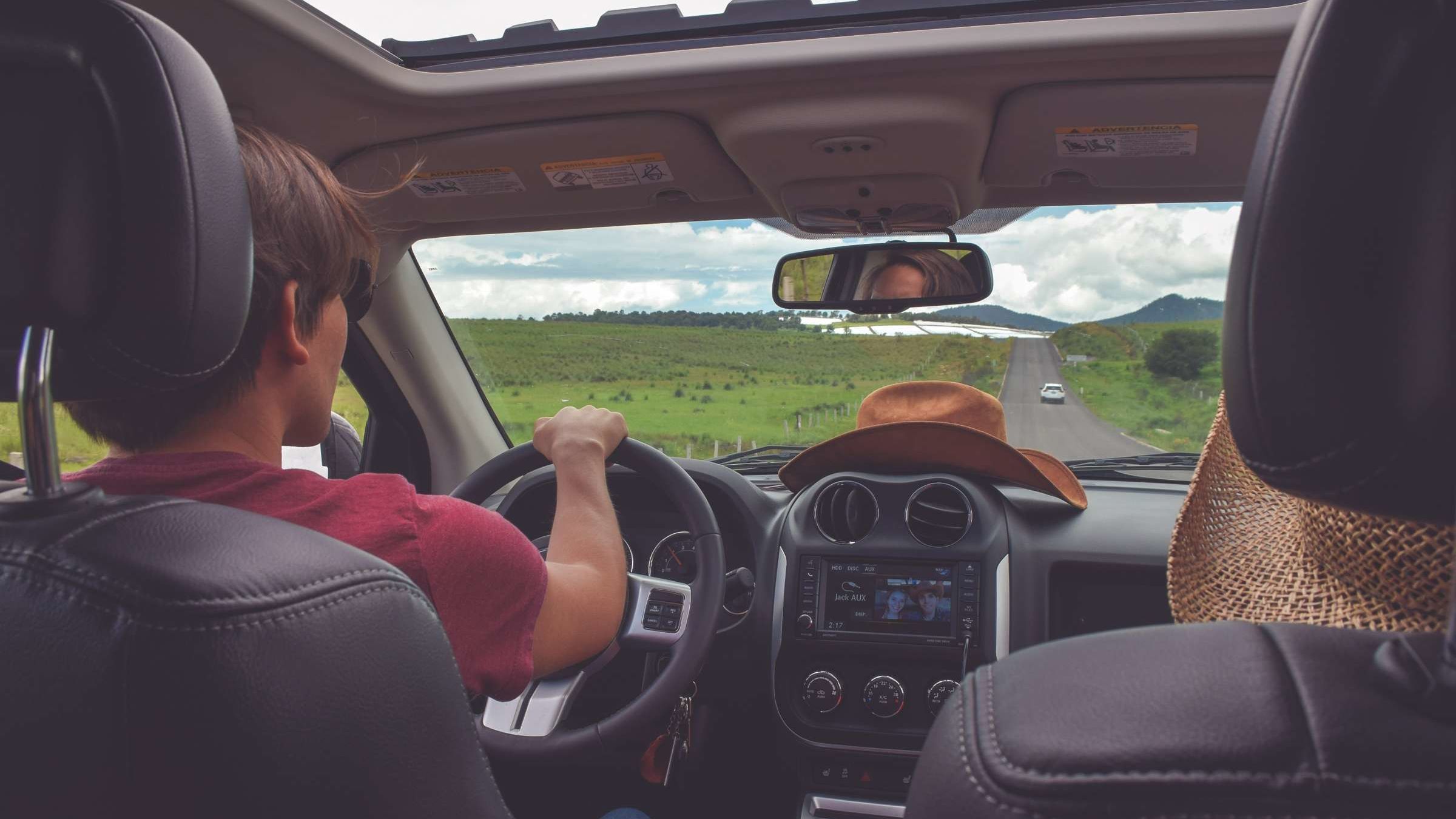
Start every day early. Rwanda’s best driving experiences — game drives at dawn, gorilla treks that begin at 7:00 AM, mountain roads before the cloud rolls in — all reward early starters. The country wakes early, and so should you.
Carry cash alongside your card. Most urban fuel stations and lodges accept cards, but rural areas and some park activities are cash only. Carry Rwandan Francs and US Dollars in small denominations.
Respect police checkpoints. They are routine and non-threatening. Greet officers politely, present your documents calmly, and do not argue about fines if they are issued. Disputed fines are paid at a designated bank, not to the officer.
Plan fuel stops around Nyungwe and the Twin Lakes. These are the two areas where stations are genuinely scarce. Carry an extra 10 liters of fuel in a certified container for the Nyungwe and Twin Lakes routes.
Never rush mountain roads. Rwanda’s highland driving is among the most beautiful in Africa — and among the most demanding. Hairpin bends, steep gradients, and sudden fog demand patience, low gear engagement, and appropriate speed. The views reward drivers who slow down. The roads punish those who don’t.
Book all permits before you book anything else. Gorilla permits ($1,500/person) and chimpanzee permits sell out months in advance. Confirm your permit dates first, then plan your driving route around them. Rwanda Car Rental Services can align your vehicle booking directly with your permit calendar.
Have a breakdown plan. Rwanda Car Rental Services provides 24/7 roadside assistance and a dedicated emergency contact number with every rental. Our vehicles are maintained to the highest standards, but the terrain of the Grand Loop is demanding. Know your emergency number before you leave Kigali.
The Right Vehicle for Every Road
Different Rwanda roads call for different rental vehicles. Here is a guide to matching vehicle to route:
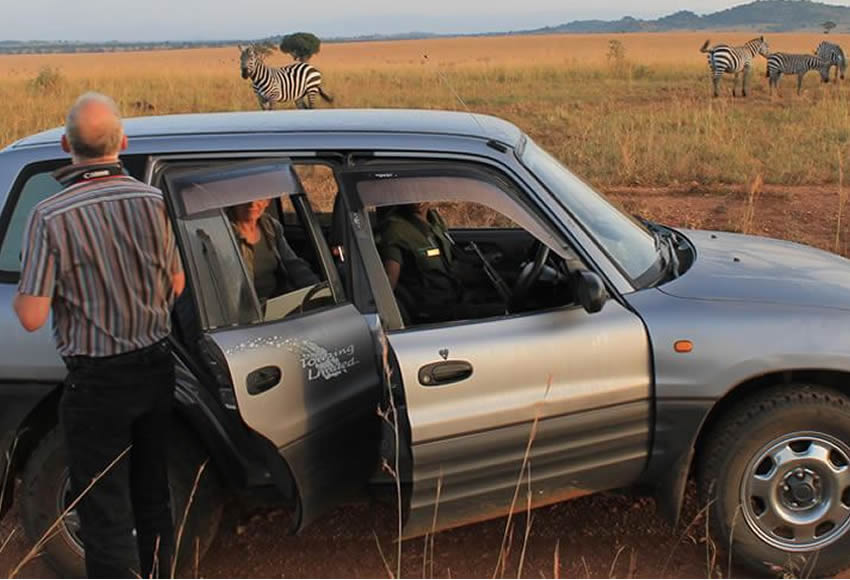
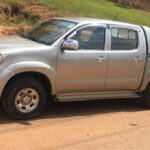
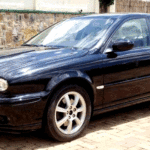
Standard sedan (Toyota Corolla, Toyota Camry): Suitable for Kigali urban driving and the paved inter-city highways (Kigali–Huye, Kigali–Musanze main route). Not recommended for national park access or the Congo Nile Trail.
Compact SUV (Toyota RAV4, Nissan X-Trail): An excellent all-rounder for most paved routes and light off-road conditions. Suitable for Musanze, Rubavu, and Huye. Adequate for dry-season Akagera. Less suited for Nyungwe rainy-season access or the full Congo Nile Trail.
Mid-size 4WD (Toyota Land Cruiser Prado): The ideal vehicle for the Grand Loop and for travelers combining city roads with national park access. Comfortable on long drives, capable on demanding tracks. Recommended for the Twin Lakes, Nyungwe, and Congo Nile Trail routes.
Full-size 4WD (Toyota Land Cruiser V8 / Hardtop): The gold standard for Akagera game drives and the most demanding sections of the Congo Nile Trail. Excellent ground clearance, serious recovery capability, and the pop-up roof configuration makes it the definitive game-drive vehicle.
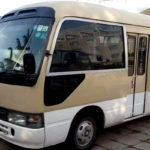
Minibus / Safari Van (Toyota Hiace 4WD): The best option for groups of 5 or more travelers, combining passenger comfort with group luggage capacity. Available in 4WD configuration for park access.
Contact Rwanda Car Rental Services to discuss the right vehicle for your specific itinerary, travel dates, and group size.
A Final Word from Rwanda Car Rental Services
Rwanda is a country that rewards curiosity, rewards early starts, and rewards the traveler willing to turn down an unmarked road and see what is there. Its ten essential driving routes range from world-class paved highways to jungle tracks that will challenge your driving and astonish your senses. Together, they trace the outline of one of Africa’s most extraordinary countries — a place that has rebuilt itself with remarkable speed and grace, and that invites the world to witness what it has become.
Every one of the ten roads in this guide leads somewhere genuinely worth going. And all of them begin in Kigali, with a set of keys from Rwanda Car Rental Services.
We are here to help you plan every kilometer — from vehicle selection and permit coordination to fuel planning, route guidance, and 24/7 roadside support throughout your journey. Contact us today to begin.
To book a rental car in Rwanda for self drive adventure along on the mentioned roads above, simply contact us now by sending an email to info@rwandacarrentalservices.com or call/chat with us on +256-700135510.
More Stories
Cross Border Car Rental: Driving from Rwanda to Uganda
Rent a Car in Rwanda For Self Drive & With A Driver
Renting a Car in Rwanda With Kids: Safety & Child Seat Tips